
Back in January 2019, I posted “Finding Waldo’s Shadier Side,” my attempt to talk about the period when Waldo south of 77th Street was outside the city limits. The city limit reached 77th by 1909, but it would be almost 40 years until that changed. My Waldo research included mentions of a lot of shady places during these years, but no proof. So, with clear disclaimer, I told what I’d heard of the story of three places, one of which was “Mary’s.
Just a few weeks ago, a person with some direct personal knowledge of the place dropped some wonderful information in my lap to share . In the realm of local lore, reality can erase a legend, but in my experience, it gives back more than it takes away.
We’ll begin with the “Mary’s” feature in an excerpt from the original piece, “Finding Waldo’s Shadier Side.”
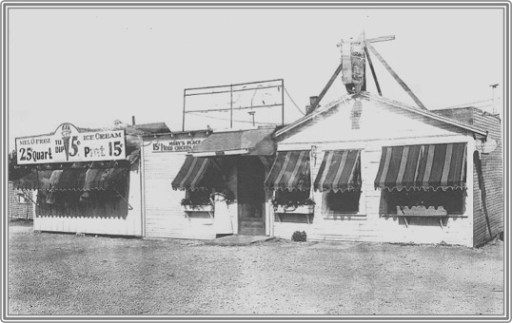
Mary’s
Of all the anecdotes I heard about Waldo’s shady side, the most frequently mentioned name was Mary’s. Through the generosity of another Waldonian, I finally found some images of the place, although most likely after its more seamy days were behind it.
When I lived in Waldo, the building that housed Mary’s was the home of Waldo Pets, at 8011 Wornall Road. It was and is an inconspicuous building on Wornall, with one exceptional feature. It was known to have, or have had, a single apartment on a small second floor. My understanding was that in recent years the property’s owner lived there (though even that I cannot verify), but in the stories I heard about Mary’s, the apartment was more of a short-term rental, as in hourly. Mary’s was also reputably a place where female wrestling was a popular attraction, but again, this is not verified information.
Mary’s had the appearance of a nightclub, with lots of small tables, a large open dance floor, and a stage at the back. Closer inspection of the interior, however, reveals a pretty shabby nightspot – mismatched chairs, a sagging ceiling, and dingy carpeting. During the Waldo Pets era, the stage was more or less intact, though at the time, I didn’t recognize it as a stage, just a platform with no purpose in the back of the room. Only one other feature belies the building’s past. On the outside, carved into the lintel over a simple wooden door, is the proof – it says simply “Mary’s.”
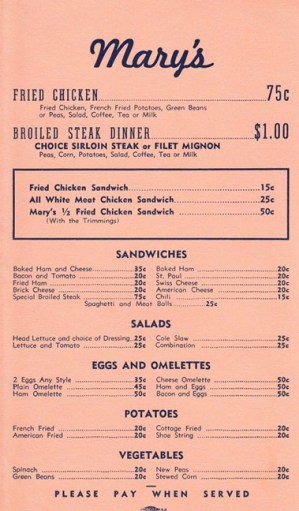
********
Now, the story, as provided by Mary’s great grandson.
“My sister Ann Marie Nixon and myself are the great grandchildren of Mary Ballman of Mary’s Nightclub fame. My sister sent me an email back in 2022 with an article about Mary’s nightclub at 80th and Wornall. I am Mary’s oldest great grandson at 77 years old. I grew up at Mary’s as a kid. My sister sent it to me as she knew I would get a chuckle from the rumor about the second floor where Mary and Anna (her daughter) lived was a brothel. The stories I have only cover the first ten years she owned Mary’s. From family stories I’ve been told she came from Italy at 15, ended up at Fort Sill during WW1, ran a dairy farm, ended up provisioning for the base and somehow became good friends with General “Black” Jack Pershing.
She came to Kansas City about 1932 and opened up a roadhouse café she named Mary’s Place, near 79th and Wornall Road. She had a chicken farm, and sold sandwiches to all the cars along Wornall, which was a main drag out of town, I’ve been told. It was her chicken that made her famous. And she sold beer for 5 cents as she was outside the city limits. She opened in 1932, and two years later expanded with an outdoor beer garden, and she added ice cream to the menu.”

One thing I do know – it was not a brothel. Despite being arch Catholic, Mary and her daughter lived there from the time I was born in 1947 until their deaths. I visited frequently as I grew up from birth in the house that was behind Mary’s. I was over at Mary’s all the time. They had great Italian food. I would visit her and Anna at least once every two weeks up through Junior High School. Every time, the sugo was on the stove”
********
So here’s what I learned. I wasn’t surprised about the brothel part. And the viewpoint of a kid living in a nightclub would logically be on the nostalgic aroma of the sugo sauce.
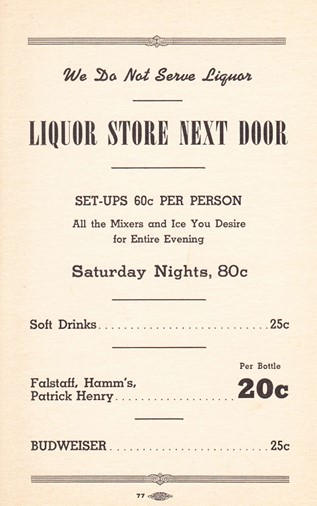

But no much on how Mary’s was one of the biggest nightclubs in the area. 1930s and 40s newspapers had a page spread on entertainment, with ads, stories and images that painted the picture. The look was all the nightclubs in all the 1930s and 40s movies, but without the glamour. Not the sleek lounges of the downtown hotels. But not without some glitter either. And as ever, showmanship.
The evening’s program was dining, dancing, and drinking, emphasis on the latter in the early years, which coincided with the end of prohibition. And even later, there were licenses required and taxes to be paid, and there likely wasn’t a bar in town that didn’t do one thing or another to dodge the law. So let it not reflect harshly on Mary, whose name was not infrequently among those in the paper who had been arrested and adjudicated regarding some liquor law or another. It was just part of the business.


 KC Backstories